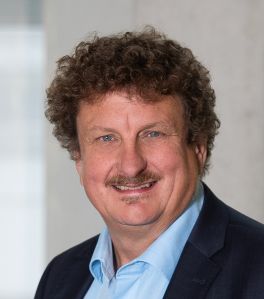
Belzig, Wolfgang
More actions

Wolfgang Belzig completed his physics studies at TU Karlsruhe (now KIT), culminating in a diploma thesis within Gerd Schön's group on superconducting proximity effects in 1995. He earned his PhD from the same institution in 1999, focusing on unconventional superconducting heterostructures. Following this, he spent two years as a Feodor-Lynen-Fellow and FOM postdoc at TU Delft, collaborating with G.E.W. Bauer and Yu. V. Nazarov. Joining the University of Basel in 2001, he worked in Christoph Bruder's group, where he obtained his Habilitation on superconductor-ferromagnet heterostructures in 2003.
In 2005, he was granted an SNF Assistant Professorship at the University of Basel and was honored with the Walter-Schottky Prize from the German Physical Society. Subsequently, he accepted a tenured W3 professorship at the University of Konstanz. From 2012 to 2019, he served as spokesperson for the DFG-funded collaborative research center SFB 767 Controlled Nanosystems and received the APS Outstanding Referee Award from the American Physical Society in 2012. Additionally, from 2015 to 2021, he contributed as a member of the Walter-Schottky-Award committee and the Council of the German Physical Society.
Since 2021, Wolfgang Belzig has served as the Spokesperson of SFB 1432 Fluctuations and Nonlinearities in Classical and Quantum Matter beyond Equilibrium.
Topological Superconductivity in Synthetic Dimensions
- Speaker: Wolfgang Belzig (Department of Physics, University of Konstanz, 78567 Konstanz, Germany)
- Event: Quantum Technology Workshop 2026
Superconductivity is a macroscopic quantum phenomenon characterized by a complex order parameter that has both an amplitude and a phase. Coupling multiple superconductors introduces additional phase parameters that can be considered synthetic dimensions. The phases control quantum states in such systems, which can be considered quantum objects living in synthetic dimensions. For example, topological objects such as Weyl singularities exist only in three dimensions and offer a route toward novel quantum states that are topologically protected. In this talk, I will explain the basics of the underlying microscopic process, Andreev reflection, which leads to phase-dependent Andreev bound states. These topological states are of fundamental interest because they can host Weyl nodes, store robust quantum information, and realize more exotic topologies. I will present examples and discuss the current state of experimental research. Besides their fundamental importance, these states offer new perspectives for superconducting quantum bits.
[1] R. L. Klees, G. Rastelli, J. C. Cuevas, and W. Belzig, Microwave spectroscopy reveals the quantum geometric tensor of topological Josephson matter, Phys. Rev. Lett. 124, 197002 (2020)
[2] H. Weisbrich, R.L. Klees, G. Rastelli, and W. Belzig, Second Chern Number and Non-Abelian Berry Phase in Superconducting Systems, PRX Quantum 2, 010310 (2021).
[3] M. Coraiola, D. Z. Haxell, D. Sabonis, H. Weisbrich, A. E. Svetogorov, M. Hinderling, S. C. ten Kate, E. Cheah, F. Krizek, R. Schott, W. Wegscheider, J. C. Cuevas, W. Belzig, and F. Nichele, Phase-engineering the Andreev band structure of a three-terminal Josephson junction, Nat. Commun. 14, 6784 (2023).
[4] D. C. Ohnmacht, V. Wilhelm, H. Weisbrich, W. Belzig, Non-hermitian topology in multiterminal superconducting junctions, Phys. Rev. Lett. 134, 156601 (2025).
[5] T. Antonelli, M. Coraiola, D. C. Ohnmacht, A. E. Svetogorov, D. Sabonis, S. C. ten Kate, E. Cheah, F. Krizek, R. Schott, J. C. Cuevas, W. Belzig, W. Wegscheider, F. Nichele, Exploring the energy spectrum of a four-terminal Josephson junction: Towards topological Andreev band structures, Phys. Rev. X 15, 031066 (2025).